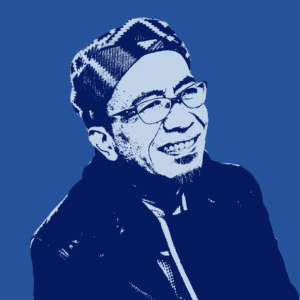
Paring Bert’s immersion in popular spirituality and social issues during the 1970s Martial Law in the Philippines led him to get attracted to the Jesuit mission of ‘Faith and Justice’. His formation was enriched by his interest in poetry, politics, and indigenous philosophy while working with the organized poor, especially when he headed the Archdiocese of Manila Labor Center before his ordination in 1991. After earning PhD in Social Anthropology in London, he engaged in teaching and research, while remaining active in indigenous peoples’ rights advocacy, peace negotiation with armed Communist and Moro groups, fighting corruption and extrajudicial killings related to the ‘war on drugs’. He cofounded the Institute of Indigenous Peoples Education, Mindanawon Initiatives for Cultural Dialogue, Sacred Springs: Dialogue Institute on Spirituality and Sustainability, and Amuma Cancer Support Group Foundation. Among his books are Ehemplo: Spirituality of Shared Integrity in Philippine Church and Society, Generating Energies in Mount Apo: Cultural Politics in a Contested Environment, Táo Pô! Tulóy! Isáng Landás ng Pag-unawà sa Loób ng Táo (National Book Award 1990), and three poetry anthologies for which he received the National Award for Poetry and Translation or Gawad Pambansang Alagad ni Balagtas, given by the Writers Union in the Philippines in 2021. Among his edited works are the 4-volume Annotated Bibliographjy of Mindanao Studies, From Zamboanga to Subic, In Search for Partnership: Conflict and Cooperation between Ancestral Domain and Economic Zone, and Listening to Our Teachers: A Study of the Views, Attitudes and Practices of Teachers and Parents of Catholic High Schools Regarding Reproductive Health, Responsible Parenthood and Sexuality Education. His music videos, like Bayang May Dangal and Meme na Mindanaw, are in YouTube. Paring Bert serves as board member of No Peace Without Justice, while teaching at the Faculty of Social Sciences, Pontifical Gregorian University in Rome.